Showing posts with label how to tell jokes. Show all posts

Tuesday, May 31, 2016

How to tell jokes: Politically Correct Jokes

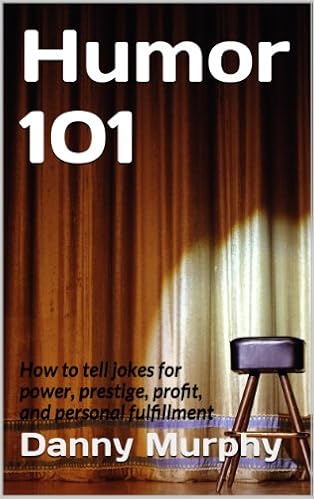
This is an excerpt from Humor 101: How to Tell Jokes for Power, Prestige, Profit, and Personal Fulfillment

“For every ten jokes, thou hast got an hundred enemies.” Laurence Sterne (Howard’s great, great, great, great grandfather.)
Politically correct jokes are jokes that are tailored not to offend certain people. The problem is that anytime anyone tries to be funny, there’s a chance he or she will offend somebody. You don’t have to tell very many jokes to find that out. And some of the people who get offended aren’t shy about saying so. Complaints about jokes can be very off the wall but it will rarely do any good to try to explain a joke to someone who feels offended. For example, there’s just no way to explain irony to someone who does not get it.
In business settings it’s a good idea not to offend people if you can avoid it. Tell jokes that have a broad appeal, that don’t play on stereotypes, and that don’t take jabs at groups of people. Unlike pitching in baseball, in comedy it’s usually better to aim for the middle of the plate than it is to try to get strikes on the corners. You want to pitch jokes that are obvious strikes. You don’t want to leave people wondering whether they got it or not. 
I recently saw a bumper sticker that said, “Meat is Murder.” Well I guess that makes me a sociopath! I love the feeling of my incisors ripping through a nice juicy steak.
As a rule, I don’t laugh very hard at my own jokes, but that one used to kill me. I really loved telling that joke. Even after I had been telling it for a while, it still made me smile inside. It’s a funny joke, but not for everybody. I’m sure I alienated many vegetarians with that joke. If I had known then what I know now, I would have dumped that joke.
Another bit I should have stopped using took pokes at balding TV personalities, especially the ones who do the comb-over. I’m sure that whenever I did that bit, I alienated many men who were, shall we say, folically challenged. Try to be aware of who might be offended by a joke and ask yourself if the joke is worth it. Sometimes it is. In business situations, it usually isn’t. 

Further reading.


#MakeAmericaLaughAgain

Related articles

Sunday, April 17, 2016

Introduction to Humor 101: How to Tell Jokes for Power, Prestige, Profit, and Personal Fulfillment


Do you want to become more attractive to members of the opposite sex? A look at the personal ads shows that a good sense of humor is the attribute people desire most in significant others. Well, next to money, anyways. Do you want mental, physical, and spiritual health? Science is proving that laughter truly is the best medicine. (Which prompts me to ask, If laughter is the best medicine, why isn’t comedy part of anyone’s health care plan?) Do you want raw unadulterated power? Humor is power. A great joke can help persuade people to support your cause or to withdraw support from your opponent’s cause.


“Against the assault of laughter nothing can stand.”
Mark Twain


Humor 101 is a self-study course for people who want to tell jokes effectively. You may be a public speaker seeking to improve your Likeability Quotient (LQ) during your opening. You may be a manager or business owner who occasionally has to make a presentation. You may have dreamed of being a standup comedian, like most people, but never found a way to work it out. Or you may just want to get better at telling jokes because you know there’s something very funny deep inside you that’s going to die a tragic death if you don’t figure out how to set it free.  


“I got started in show business very young. My mother swears I performed prenatally. She says I got a few laughs on the way to the hospital. It was the best womb I ever played.”
Billy Crystal from Absolutely Mahvelous


Many people have mistakenly believed the myth that a sense of humor is inborn – that it cannot be learned or taught. It’s true that few people are born with as good a sense of humor as Billy Crystal was blessed with. Even with diligent practice, few people stand much of a chance of becoming as funny as him. However, while it is true that some people are born with more natural comedic abilities than others, even people who have been clinically diagnosed as laugh-impaired can learn how to tell jokes by applying the simple techniques of Humor 101. And anyone who can tell a dozen jokes well will become the life of many parties, dazzling friends and colleagues.  


“In business, ideas presented with humor gain more support, and after five, the person who gets more laughs gets more dates.”
Judy Carter from Standup Comedy


Al Gore was a fine example. When he took office as Vice President, he was horribly, tragically unfunny. It’s amazing that he got as far as he did in politics without having a clue about how to tell a joke. By the 1996 campaign, he and his handlers realized it was a big problem, and they worked on his sense of humor. It worked! Al Gore mastered the art of self-deprecation and he learned how to tell jokes. His stiffness had been a liability. When he learned how to tell jokes, his stiffness became the setup for most of them. He’s an inspiration to all who have the hope of becoming funny.


“They laugh that win.”
Othello


Laughing and winning frequently go together. Unfortunately, it didn’t work out that way for Al Gore. However, after he lost the election of 2000, he went on to host Saturday Night Live and he did a decent job, probably a better job than he would have done as President. The point is,if Al Gore can learn to tell jokes, anyone can. As you do, you will reap the benefits that joke-tellers all over the world have been reaping since the dawn of creation. Power, prestige and personal fulfillment – not to mention truckloads of money – can all be yours when you master a few simple techniques.


But this course will not only teach you how to tell jokes. Humor 101 will also show you where to find jokes and how to pick appropriate jokes. I tip my hat to you as you strive to improve yourself. By studying this material, you’re already showing that you have the desire to tell jokes, and that’s the first key. When you learn how to tell jokes, you will not merely be improving yourself. You’ll be improving the world we all live in. I commend you for that!


“Without laughter life on our planet would be intolerable.”
Steve Allen from Funny People

Sunday, January 10, 2016

Learn how to tell jokes from the masters


None of the people who have done well in comedy have gotten there on natural ability alone. The people at the top are talented but they have also worked hard and learned a lot along the way.

Brian Regan is one of my favorites to watch and I got to see him twice when he was working comedy clubs. I laughed so hard that my ribs were actually sore by the end of his sets. (Those were the only two times in my life for that to happen.)

If you want to tell jokes like the masters, don’t just sit back and watch. Analyze what they do. Go to live comedy shows if you can and watch how the pros use the various devices of comedy. Here are three of the obvious things to watch for: 

  • Energy level. Some comedians are very energetic and others not so much. Be mindful of what might work for you in your public speaking situations.
  • Gestures and movement around the stage.Most comedians are very aware of the space available and how to use it. Some move around a lot and some stay right by the mic stand. Some mix it up.
  • Comedic timing. Comedians have a sense for how much of a pause to leave between the setup and the punchline. They also have a sense for when to move into the next joke. I’ve seen public speakers who didn’t give the audience time to digest the setup or the punchline and how moved forward a bit too quickly. It’s a serious mistake but it’s one of those things that gets better with practice. 

I used to go to a comedy club nearly every week on a night that was sponsored by a country radio station. It was particularly interesting and educational when there was a black performer for the predominantly redneck audience.

One of the best opening jokes I’ve ever seen was by a very good comedian named Special K. He came to the microphone, took a good look around at the nearly all white audience, and said “Rooster Country. Not a very popular station with the brothers, is it?” 

Just like that, he addressed the fact that he was a black performer for a mostly white audience. It was a very funny joke and it got a good laugh. Special K had a very good set. What did I learn? If there's some potential issue at a speaking engagement, deal with it up front with some humor.

If you found this post useful, share it with your friends and colleagues. The sharing buttons are below.

If you liked this tip about telling jokes, you can find many more in Humor 101: How to Tell Jokes for Power, Prestige, Profit, and Personal Fulfillment. Check it out.